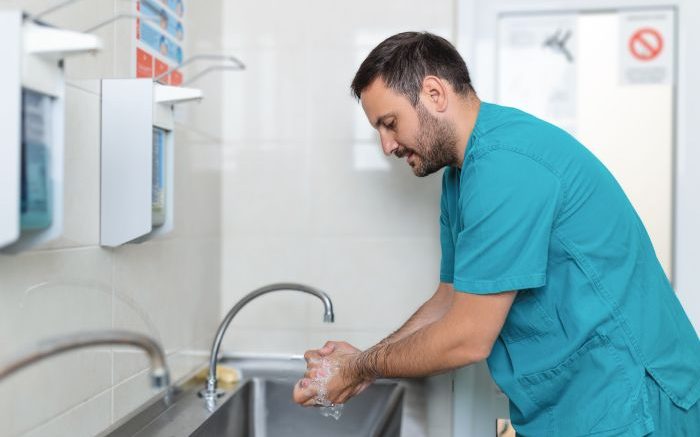
Hand hygiene is vital for infection prevention, yet compliance among medical staff remains low. This study by Wong S-C, et al. (2025) assessed whether training medical students using a multimodal educational intervention, including their roles as hand hygiene covert observers (HHCOs) in their pre-internship phase, could improve hand hygiene compliance during their internship.
A retrospective study was conducted at Queen Mary Hospital, Hong Kong, comparing two consecutive cohorts of medical interns: cohort A (historical control, starting July 1, 2024) and cohort B (intervention group, starting July 1, 2025). Cohort B participated in a half-day training workshop and covertly observed hand hygiene compliance as HHCOs during a 19-day pre-internship clinical attachment in June 2025. Hand hygiene compliance observed by HHCOs was compared with infection control nurses (ICNs) observations collected concurrently. Additionally, hand hygiene compliance among cohorts A and B was monitored by ICNs using World Health Organization audit tools. Baseline knowledge and attitudes of cohort B regarding hand hygiene were assessed by questionnaire.
Seventy-four pre-interns in cohort B completed the baseline questionnaire; 38 (51.4%) identified alcohol-based hand rub (ABHR) as the most effective hand hygiene method, while 36 (48.6%) selected soap and water. Positive attitudes were evident, with 54 (73.0%) strongly agreeing on hand hygiene’s role in preventing healthcare-associated infections and 52 (70.3%) strongly agreeing that compliance impacts patient safety. During the pre-internship clinical attachment, hand hygiene compliance observed by HHCOs among cohort A was significantly higher than that observed by ICNs (96%, 682/713 vs. 59%, 144/244; p < 0.001). Comparison of ICN-observed compliance showed a non-significant increase for cohort B versus cohort A (66%, 230/348 vs. 58%, 156/267; p = 0.051). However, cohort B demonstrated a significantly higher proportion of hand hygiene episodes using ABHR compared to cohort A (90%, 208/230 vs. 79%, 123/156; p = 0.001).
The authors conclude that engaging pre-interns in a multimodal educational intervention, including their roles as covert observers, did not significantly increase overall hand hygiene compliance compared to historical controls. However, there was a notable rise in ABHR use among the intervention group. This approach may promote awareness and foster a culture of patient safety.
Reference: Wong S-C, et al. Does a multimodal educational intervention involving pre-intern ‘hand hygiene covert observers’ improve hand hygiene compliance among medical interns? Antimicrobial Resistance & Infection Control. Dec. 28, 2025.