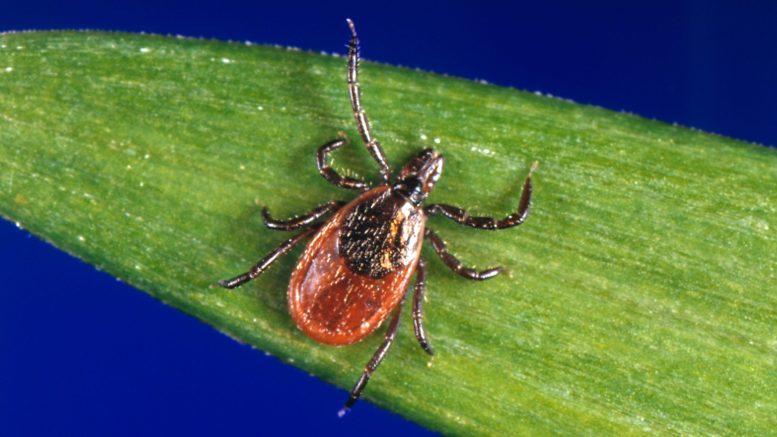
Lyme, Connecticut is a small, rural town on the eastern bank of the Connecticut River. It is home to hiking trails and protected marshes with good birdwatching. It is also ground zero for Lyme disease, a tick-borne illness first detected in the United States in this quiet hamlet. Working with Connecticut public health officials, two Yale School of Medicine researchers were the first to identify Lyme Disease as a tick-borne illness, making treatment, and often a cure, possible.
In 1975, Lyme mom Judith Mensch kept hearing about children in her neighborhood coming down with an arthritis-like illness. She told the New York Times that year, “It didn’t seem too unusual when we heard of the first case. That was the girl next door who got it about a year and a half ago. She had to be in a wheelchair on the third attack. Then it hit the little girl around the corner. And after that it was the boy down the street.”
When her own 8-year-old daughter’s knee swelled so much she could barely walk, Judith rejected a diagnosis of juvenile arthritis, aware of how unusual such a cluster of cases would be. Instead, she gathered the names of a dozen others with similar symptoms and called the State Health Department.
Meanwhile, three miles to the north, three members of Polly Murray’s family had also become ill, with similar symptoms. She called the health department, too.
The state enlisted Yale School of Medicine rheumatologists Allen Steere, MD, and Stephen Malawista, MD, to investigate what was happening.
In late 1975 and 1976, the researchers surveyed the area and found 51 cases (39 children and 12 adults) with similar symptoms in the neighboring towns of Lyme, Old Lyme, and East Haddam. Most lived near wooded areas and developed symptoms in summer or early fall. Many recalled a distinctive bullseye-shaped rash weeks before onset—a clue that suggested an insect bite.
Steere and Malawista reviewed medical literature on similar rashes and found that investigators in Sweden had, a decade earlier, linked them to bites from ticks—small blood-sucking arachnids.
They hypothesized that ticks were transmitting a bacterial infection and coined the term “Lyme arthritis.”
Working with epidemiologists and game officials, the team identified areas east of the Connecticut River with higher concentrations of deer ticks, which mirrored the geographic distribution of the disease.
By 1977, they had established a strong epidemiologic link between tick bites and the illness. In 1982, entomologist Willy Burgdorfer. PhD, of Montana’s Rocky Mountain Laboratories identified the bacterium that caused the infection: Borrelia burgdorferi.
As their research progressed, Steere and Malawista launched an education campaign in Lyme and surrounding communities. They partnered with local healthcare providers to ensure patients with Lyme symptoms were quickly referred to Yale. Their ongoing investigations revealed that the illness could affect not only the joints, but also the nervous system and the heart. In 1979, recognizing the broader scope of the condition, they changed its name from Lyme Arthritis to Lyme disease.
Initial attempts to treat Lyme Disease symptoms with anti-inflammatory drugs proved ineffective. However, antibiotic treatment led to rapid improvement and often full recovery. Even advanced cases, such as Lyme meningitis affecting the central nervous system, responded well to antibiotic therapy. By the early 1980s, Yale researchers had developed Lyme Disease treatment protocols that remain foundational in clinical guidelines today.
Lyme disease has now spread well beyond the tiny town in which it was first identified. Cases have been found in every U.S. state, though the disease remains most prevalent in the Northeast, mid-Atlantic, and upper Midwest regions.
Because symptoms can be vague and not all cases are diagnosed or reported, Lyme disease is considered underrecognized. The Centers for Disease Control and Prevention (CDC) estimates that approximately 476,000 Americans are diagnosed and treated for Lyme Disease each year. Connecticut alone reports roughly 30,000 cases annually, among the highest rates in the nation.
The efforts of Drs. Steere and Malawista to identify the mysterious illness that first surfaced in Lyme, Connecticut were critical to understanding its cause—and how to treat it.
Today, Yale researchers continue to study Lyme disease’s complex biology, including why some patients develop persistent symptoms after treatment. Promisingly, investigators are working toward a vaccine using mRNA technology that targets tick saliva proteins, a novel approach designed to block transmission before infection begins.
Lead researcher, Yale School of Medicine’s Erol Fikrig, MD, Waldemar Von Zedtwitz Professor of Medicine (Infectious Diseases) and professor of epidemiology (microbial diseases) and of microbial pathogenesis, hopes to have a Lyme vaccine, hopes to have one within five to 10 years.
Source: Yale School of Medicine