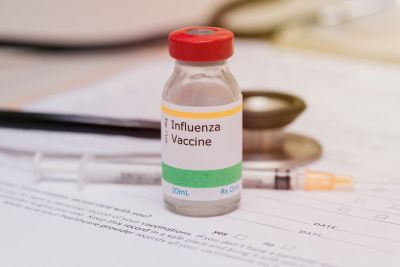
Vaccination is the safest and most effective way to prevent infectious diseases, say Krauland, et al. (2025), who add that it not only reduces disease in the vaccinated portion of a population but also potentially provides indirect benefit to the unvaccinated portion. Indirect benefits to the unvaccinated portion in a population are difficult to estimate since indirect benefits cannot be determined from the general population simply. In their study, the authors sought to estimate the influenza case burden, both direct and indirect, averted by vaccination using an agent-based model, which models agents as individuals in the simulation population.
In this decision analytical modeling study, simulations included varied levels of virus transmissibility, vaccine effectiveness, and vaccine uptake among the 2010 Allegheny County, Pennsylvania, census population. Simulations were run from August 15, 2022, to May 31, 2023. Individuals were vaccinated beginning in September of the simulation year.
The population used in this study consisted of 1,218,695 agents (median [IQR] age, 40.6 [3.6-77.6] years; 51% female) and was statistically similar in demographics to the 2010 Allegheny County census population. The mean (SD) burden of influenza averted by vaccination with a vaccine effectiveness of 40% ranged from 32.9% (0.9%) in the high transmission scenario to 41.5% (3.4%) in the low transmission scenario for seasonal influenza. In the model, indirect benefit to the unvaccinated portion of the population was found over a range of modeled transmissibility characteristics of seasonal influenza and varied levels of vaccine effectiveness and vaccination coverage; however, direct benefit to the vaccinated portion was greater in all scenarios. At the highest levels of transmissibility, such as might be found in pandemic influenza, indirect benefit decreased and eventually disappeared.
In this study, influenza vaccination provided substantial benefit in reducing infections to both the vaccinated and unvaccinated portions of the population. Even when both vaccine effectiveness and vaccine uptake were low, vaccination showed marked reductions in disease burden for transmission levels characteristic of seasonal influenza. However, when the level of transmission was very high, even a highly effective vaccine did not protect unvaccinated individuals. These findings underscore the importance of vaccination in disease prevention and control and show that indirect benefits are limited in high transmission situations.
Krauland MG, et al. Estimated Burden of Influenza and Direct and Indirect Benefits of Influenza Vaccination. JAMA Netw Open, Published Online: July 16, 2025; 2025;8;(7):e2521324. doi:10.1001/jamanetworkopen.2025.21324