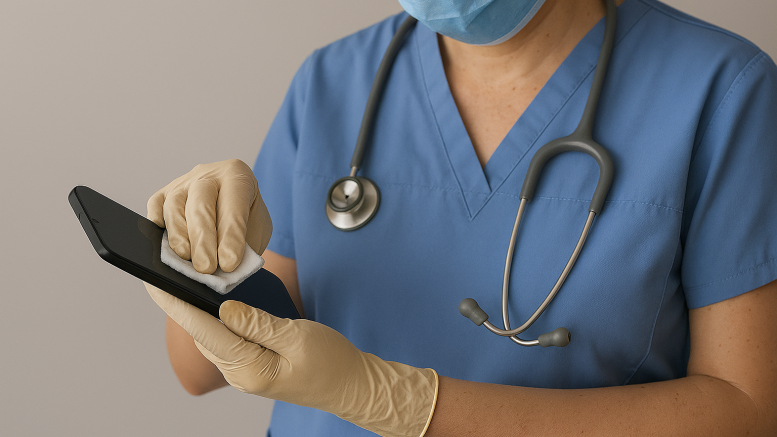
Poor cleaning practices for healthcare workers’ mobile phones can promote microbial contamination, posing a latent risk of infections for patients. Despite widespread mobile phone use in healthcare environments, evidence on the effectiveness of disinfection methods in low and middle-income countries remains limited. Torres-Lévano, et al. (2026) sought to evaluate the disinfectant capacity of 70% isopropanol on the surface of healthcare workers’ smartphones in a Peruvian hospital in 2023.
The researchers designed a pre-post study to collect demographic, occupational, and phone usage information, along with microbiological culture analysis results before and after cleaning with 70% isopropanol. They evaluated 178 mobile phones from healthcare workers, 90.5% (95%CI: 85.1–94.0%) of which showed microbiological contamination. The most frequently isolated microorganism was Staphylococcus aureus (41.0%), followed by Enterococcus sp. (14.9%) and Staphylococcus epidermidis (9.9%). Antibiogram analysis revealed high resistance rates to ampicillin. No factors were associated with microbial contamination on phones. A significant reduction in microbiological contamination was observed (90.4% to 14.0%, p < 0.001) after cleaning with 70% isopropanol. Colony counts significantly decreased from 73.4 ± 31.8 CFU/cm2 to 3.9 ± 11.0 CFU/cm2 (p < 0.001).
The disinfectant capacity of 70% isopropanol on healthcare workers’ smartphone surfaces is highly effective, resulting in an approximately fivefold reduction in contamination rates, the researchers concluded.
Reference: Torres-Lévano, E., Moya-Salazar, J., Li, J. et al. High efficiency of 70% isopropanol in reducing microbial contamination on healthcare workers’ smartphone surfaces: a pre-post study in Peru. Antimicrob Resist Infect Control (2026). https://doi.org/10.1186/s13756-025-01692-6